
Create greater tax flexibility, improve retirement efficiency, and keep more of the wealth you’ve worked hard to build.

Most people focus on investment returns.
Few focus on the impact taxes may have on their long-term wealth.
Income taxes, capital gains taxes, and retirement account distributions can significantly reduce what you keep over time. Without a tax-efficient strategy, a substantial portion of your retirement income may go to taxes rather than toward your goals.
Most people focus on investment returns. Few consider how taxes may impact long-term wealth and retirement income. Without a tax-efficient strategy, a significant portion of your future income may go toward taxes.
Many investors build retirement savings primarily inside tax-deferred accounts such as:
✅ 401(k)s
✅ Traditional IRAs
✅ SEP IRAs
✅ SIMPLE IRAs
While these accounts may provide immediate tax benefits, future withdrawals are generally taxable as ordinary income.
Tax diversification helps create flexibility by spreading assets across different tax treatments.
Many retirement savers rely heavily on tax-deferred accounts like 401(k)s and Traditional IRAs. Tax diversification creates flexibility by spreading assets across multiple tax treatments.

Brokerage accounts and investments that provide liquidity and flexibility.
Retirement accounts that postpone taxation until withdrawals begin.
Roth accounts and other tax-advantaged strategies that may provide greater flexibility in retirement.
Roth accounts and certain insurance strategies that may provide tax-advantaged access to income in retirement.
By spreading assets across multiple tax buckets, retirees may have more options when managing income, responding to legislative changes, and navigating retirement expenses.
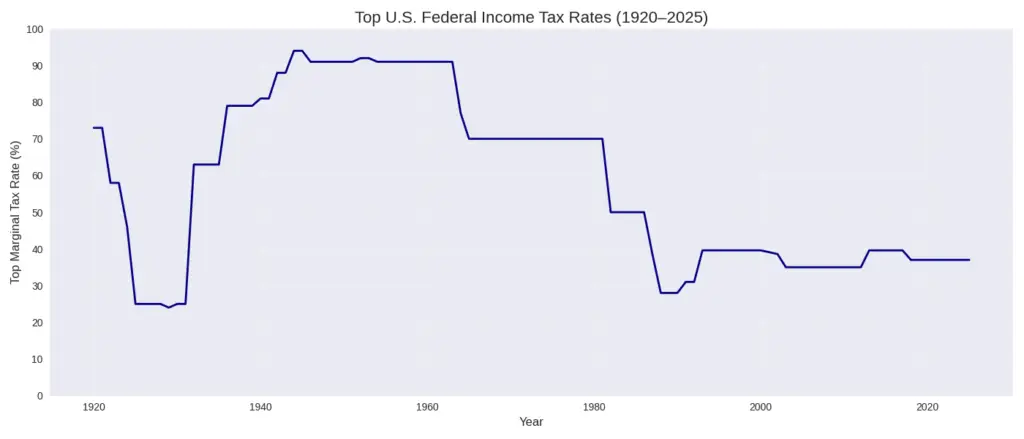
Tax rates have varied significantly throughout U.S. history.
Many retirees assume they’ll be in a lower tax bracket later in life, but future tax laws, required minimum distributions, pensions, Social Security income, and other factors can create very different outcomes.
That’s why many investors focus on flexibility rather than relying entirely on one type of retirement account.
Tax rates have changed significantly throughout history and may change again in the future. That’s why many retirees prioritize flexibility rather than relying entirely on one type of retirement account.
Tax planning isn’t about finding a single solution. It’s about creating flexibility.
A well-designed retirement strategy often includes assets across different tax buckets, allowing you to better manage income, reduce tax exposure, and adapt to changing tax laws throughout retirement.
Common tax-efficient planning tools may include:
No single strategy is right for everyone. The goal is creating a mix of assets that provides flexibility and greater control over how retirement income is generated.
Tax planning isn’t about finding a single solution. It’s about creating options and flexibility throughout retirement. Common strategies include:
✅ Roth IRAs
✅ Roth conversions
✅ Health Savings Accounts (HSAs)
✅ Tax-Aware Investment Management
✅ Strategic withdrawal planning
✅ Municipal Bonds
✅ Tax-Efficient Business Strategies
✅ Cash Value Life Insurance Strategies
✅ Roth IRAs
✅ Roth conversions
✅ Health Savings Accounts (HSAs)
✅ Strategic withdrawal planning
✅ Tax-Aware Investing
✅ Tax-Free Income Strategies
No single strategy is right for everyone. The goal is creating a mix of assets that provides flexibility and greater control over how retirement income is generated.
Tax diversification involves spreading assets across taxable, tax-deferred, and tax-free accounts to create greater flexibility when generating retirement income.
Future tax rates, retirement income sources, and distribution requirements are unknown. Having multiple tax buckets may provide more options later in retirement.
Examples may include Roth IRAs, Roth 401(k)s, and certain properly structured insurance-based strategies.
Not necessarily. While higher-income individuals often face greater tax exposure, many families can benefit from evaluating tax-efficient planning opportunities.
Many investors use 401(k)s effectively, but relying exclusively on one account type may limit future flexibility. Evaluating multiple tax buckets may create additional planning opportunities.
Tax diversification involves spreading assets across taxable, tax-deferred, and tax-free accounts to create greater flexibility when generating retirement income.
Future tax rates, retirement income sources, and distribution requirements are unknown. Having multiple tax buckets may provide more options later in retirement.
Examples may include Roth IRAs, Roth 401(k)s, and certain properly structured insurance-based strategies.
Not necessarily. While higher-income individuals often face greater tax exposure, many families can benefit from evaluating tax-efficient planning opportunities.
Many investors use 401(k)s effectively, but relying exclusively on one account type may limit future flexibility. Evaluating multiple tax buckets may create additional planning opportunities.
Saving on taxes isn’t about chasing loopholes. It’s about creating flexibility, improving efficiency, and keeping more of what you’ve worked hard to build.
M&M Wealth Associates values your privacy and is committed to helping make your experience with our website safe, secure, and informative. This Privacy Policy explains how we collect, use, and share information you provide when accessing or using our website.
This website is intended for use by individuals who are at least 18 years of age and who are accessing the website from within the United States.
By using this website or submitting information through it, you acknowledge that:
This Privacy Policy is incorporated into and subject to the website’s Terms of Use.
We may collect both personally identifiable information (“PII”) and non-personally identifiable information (“Non-PII”).
Examples include:
Examples include:
For purposes of this Privacy Policy, both categories may be referred to collectively as “Information.”
We may collect information when you:
We may also automatically collect certain information through cookies, browser information, analytics tools, and similar technologies.
Information automatically collected may include:
Cookies may be used to improve website functionality, personalize user experiences, and support website analytics.
Information collected through the website may be used to:
We may share information with service providers and business partners who assist us in operating our business and servicing client needs.
We may also disclose information when:
By submitting information through this website, you consent to being contacted through the information you provide, including by:
You may opt out of future promotional communications at any time.
To request removal from promotional communications, please contact:
M&M Wealth Associates
2900 S Harbor Blvd, Suite 225
Santa Ana, CA 92704
Phone: (714) 494-9515
Please allow up to 10 business days for processing. Administrative or legally required communications may still be sent when permitted by law.
We maintain reasonable administrative, technical, and physical safeguards designed to protect information from unauthorized access, use, disclosure, alteration, or destruction.
However, no method of transmission or storage is completely secure, and we cannot guarantee absolute security.
If a security incident occurs, we may notify affected individuals electronically when permitted by law.
If you believe website security has been compromised, please contact us at:
(714) 494-9515
M&M Wealth Associates reserves the right to update or modify this Privacy Policy at any time.
Changes become effective immediately upon posting to the website. Continued use of the website constitutes acceptance of any updated Privacy Policy.
If you have questions regarding this Privacy Policy, please contact:
M&M Wealth Associates
2900 S Harbor Blvd, Suite 225
Santa Ana, CA 92704
Phone: (714) 494-9515